Anthropic's Claude Code source leaked via npm. Buried inside: a pixel pet system called Buddy. We turned it into an open-source toy in a day.
We Found a Hidden Pet System in Claude Code's Leaked Source and Shipped It Overnight
On March 30th, 2026, Anthropic accidentally shipped a 59.8 MB source map file inside their Claude Code npm package. Within hours, the entire 512,000-line TypeScript codebase was mirrored across GitHub and picked apart by thousands of developers. Buried inside that code, alongside feature flags for autonomous agents and undercover commit modes, was something nobody expected: a fully built virtual pet system called Buddy.
We all know what happened yday with Claude Code. Buried in the source: a hidden pet system called "Buddy." Every user gets a unique pixel creature based on their ID. Deterministic, same hash, same buddy, every time. So @peronif5 and I did the most sensible thing... Shipped it.… pic.twitter.com/YE4ZSEIXq7
— Agnel (🇵🇷) (@agnelnieves) April 1, 2026
What Happened with the Claude Code Leak
@anthropic-ai/claude-code package on npm included an unminified source map — cli.js.map — containing the full, readable TypeScript source. By 4:23 AM ET, it was public. By noon, the internet had catalogued every hidden feature, internal codename, and unreleased capability Anthropic had been quietly building.Among the bigger discoveries:
- KAIROS — an always-on daemon mode that lets Claude Code operate as a persistent background agent, watching, logging, and acting without waiting for user input
- Undercover mode — auto-activated for Anthropic employees on public repos, stripping AI attribution from commits
- 44 feature flags covering unreleased functionality
- And tucked away, a complete companion pet system called Buddy
The Buddy System: A Pixel Pet for Every User
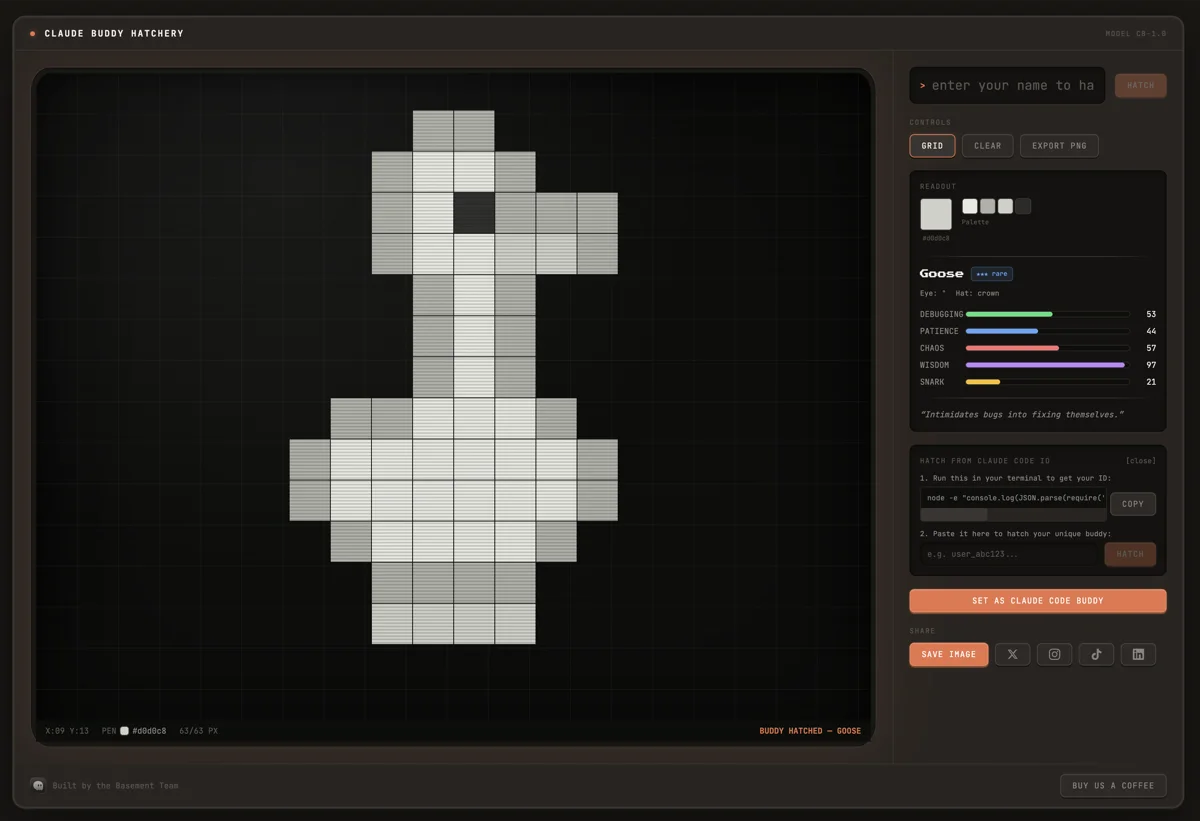
The Buddy system was fully implemented. Every Claude Code user was supposed to get a unique pixel creature generated deterministically from their user ID. Same hash, same buddy, every time. The code included 18 species across rarity tiers, stat generation, personality descriptions — the whole gacha experience, just waiting to be turned on.
It was the kind of detail that makes you smile. In a tool built for productivity and code generation, someone at Anthropic took the time to build a pet system. A little pixel friend that lives in your terminal. That's the kind of craft and whimsy that makes developer tools memorable.
The moment I saw it, I knew what we had to do.
From Discovery to Deploy in a Day
Peroni and I have a rhythm. We spot something interesting, we build. No planning committee, no Jira tickets, no "let's circle back Monday." As a design engineer with 15+ years of shipping products, I've learned that the best side projects are the ones you can't not build. This was one of those.
Here's what we shipped:
- 12 unique pixel art species across 5 rarity tiers — from common Blobbits to the legendary Nebulynx (3% chance)
- Deterministic generation — same name always produces the same buddy, making them feel like yours
- Shiny variants with a 5% drop rate, because of course
- Buddy stats — Vibe, Chaos, Focus, and Luck, each randomly rolled but consistent to your hash
- One-command terminal install —
curla script and your buddy appears in your Claude Code statusline - Social sharing — download as PNG, share via URL, generate QR codes, post to X/LinkedIn with pre-populated text
The whole thing runs on Next.js 15, renders sprites on HTML5 Canvas, and uses a Mulberry32 PRNG seeded by a DJB2 hash of your input. No backend, no database, no authentication. Pure deterministic fun.
Why Build This?
Developer tools don't have to be purely utilitarian. The best ones have personality. They reward curiosity. They make you want to open the terminal. A pixel pet that lives next to your cursor won't make you a better programmer, but it might make the work feel a little less solitary.
Anthropic clearly felt the same way — they built the whole thing, ready to ship. We just opened the door a little early.
How the Generation Algorithm Works
For the technically curious, the generation is straightforward:
- Take the input string (name or user ID), lowercase and trim it
- Salt it with a fixed string to avoid collisions
- Run a DJB2 hash to convert it to a numeric seed
- Feed that seed into a Mulberry32 PRNG
- Roll for species (weighted by rarity tier probabilities)
- Roll for shiny status (5% chance)
- Generate four stats between 1 and 99
- Select a soul description from the species pool
Same input, same seed, same rolls, same buddy. Every time. No server involved.